


By Rasmus Lindqvist , Data Lead, Cling Systems
-
Introduction
-
The Anatomy of a Battery: Understanding its Layers
-
Reading a spec sheet
-
A note on Battery Passports
-
Conclusion
Introduction
When sourcing batteries for repurposing and recycling, the first task is coming to terms with the nitty gritty: a detailed understanding of their technical specifications.
At first glance, the technical specifications of a battery might seem straightforward. However, as veterans in the field would attest, this task is anything but. There are many batteries, each possessing unique characteristics. Gathering comprehensive technical data can feel like searching for a needle in a haystack. This crucial information is often scattered across numerous PDFs and Excel datasheets in static form, making the quest for comparing spec sheets a real pain and questions like…
-
What is the current availability of Tesla Model S 85 kWh batteries in the market?
-
How many 14S2P battery configurations exist currently?
-
What is the total tonnage of NMC (Nickel Manganese Cobalt) materials available?
... close to impossible to answer.
The Anatomy of a Battery: Understanding its Layers
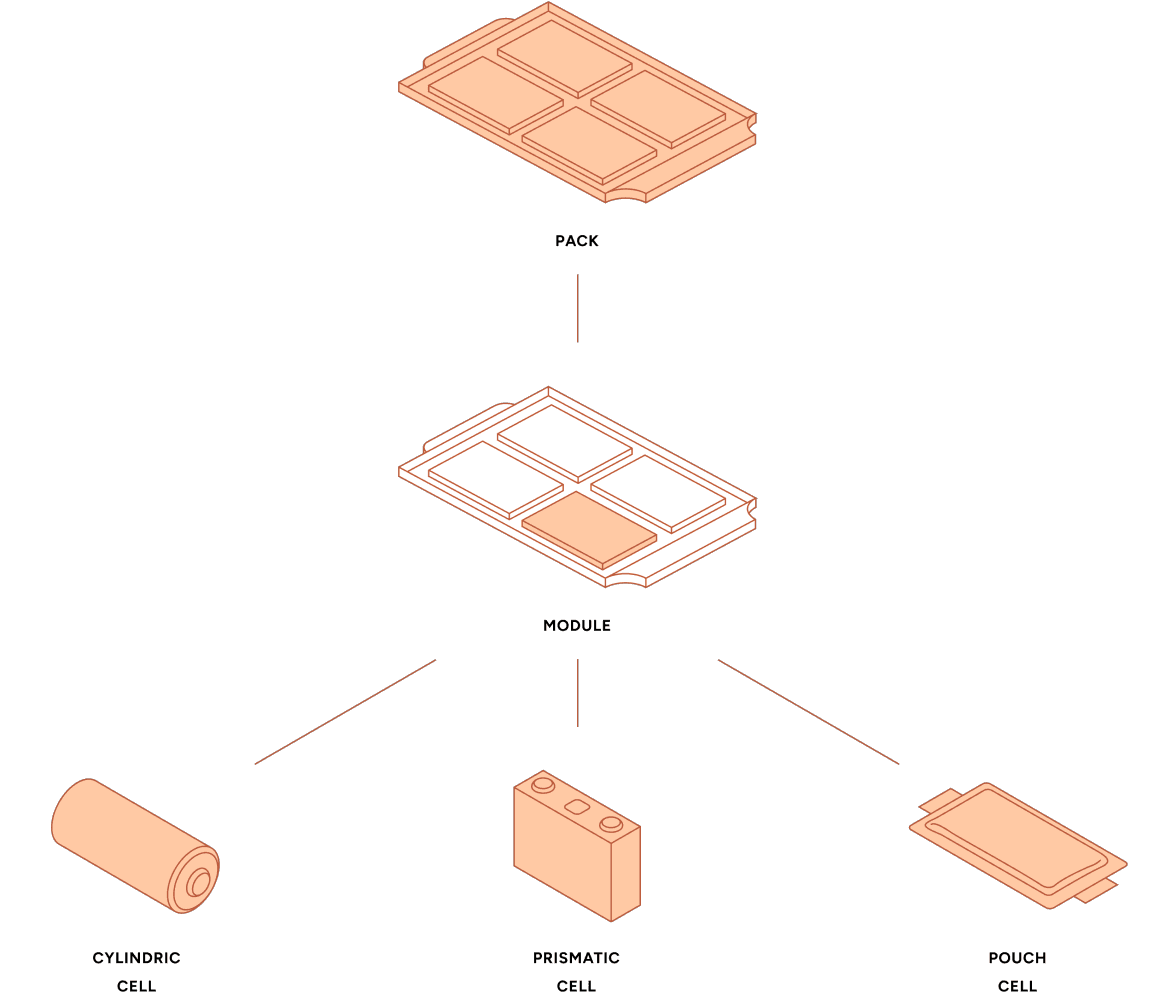
To truly grasp the significance of a battery's technical specifications, it's essential to understand its layered structure. A battery is a complex assembly, composed of various layers that contribute to its overall functionality:
-
Raw Materials: These are the essential elements that form the base of the battery, including Lithium, Cobalt, Nickel, Graphite, Manganese, and Copper.
-
Cell: These are the fundamental electrochemical units where electrical power is generated.
-
Module: This layer consists of groups of cells that are bundled together to improve packaging and reliability.
-
Pack: This is the topmost layer, where modules are combined into a fully integrated system, ready for deployment.
The structure of batteries reveals a complex, yet ordered, hierarchy, from cells to modules to packs, each layer building upon the last. This progression from cells to modules to packs illustrates not only a hierarchical organization but also a significant expansion in diversity at each level. While the range of cell types remains relatively fixed, the potential combinations into modules increase, and from these modules, the variety of packs multiplies even further. Similar to the branches of a big family tree.
Understanding this layered architecture offers a strategic advantage for buyers. If a buyer is targeting a specific module, recognizing that it may be incorporated into multiple pack types expands their sourcing possibilities. This is crucial because it opens up avenues to find the desired module within different pack configurations. Potentially giving options that are more readily available or cost-efficient. A key benefit in a nascent market that is still opaque and lacking transparency.
Reading a spec sheet
To navigate the complexities of battery specifications, it helps to standardise how you read every sheet. Whatever the format — a tidy OEM datasheet or a scanned PDF from a dismantler — work through the same checklist so you can compare like with like:
-
Identity: make, model, and the cell/module/pack level you’re actually being offered.
-
Chemistry & format: LFP or NMC; cylindrical, prismatic or pouch; and the series/parallel configuration (e.g. 14S2P).
-
Energy & voltage: nominal capacity (Ah), energy (kWh), and nominal/working voltage.
-
Condition: state-of-health where known, cycle history, and crucially whether the batch is graded or simply listed "as found."
-
Provenance & compliance: where it came from, how it was handled, and what documentation travels with it.
Mapping how batteries connect at the cell, module, and pack level — the family tree mentioned above — is what lets you navigate between the layers and spot alternative supply. If the exact module you want is scarce, recognising which pack types it sits inside opens up options that may be more available or better priced.
When you’re evaluating a real batch, the same layered thinking helps stakeholders such as BESS builders, OEMs and recyclers judge what end-of-life (EOL) supply is worth — from raw materials through to complete packs. Those initial questions at the top of this piece — how many Tesla modules are around, how many 14S2P configurations exist, how much NMC tonnage is out there — are exactly the kind of market picture the desk builds from real, current stock rather than a static catalogue.
A note on Battery Passports
As the industry grapples with the challenge of disparate battery information, the proposed "Battery Passport" concept serves as a tentative step toward organization. This initiative, still in its early phases, is expected to offer a more structured approach to battery data, potentially easing the journey for those in the market for End-of-Life batteries.
Aiming to bring some level of standardization to technical specifications, the hope is that the Battery Passport may simplify some aspects of data assessment. With its full implementation for new batteries slated for 2027 under the EU battery regulation, its practicality and scope remain subjects of ongoing deliberation and finessing. For now, it represents a cautious optimism for a more streamlined approach in battery information management. There are multiple proposed battery passports, and the extent to which they will be interoperable is to be determined, but they will all need the right trading structure to be useful.
Cling is keeping an eye on developments with our own pilot with a leading Digital Product Passport (DPP) startup. More to come on that later.
Conclusion
Understanding the technical specifications of second-life batteries is a pivotal first step in leveraging their potential for sustainable energy solutions. Despite the challenges posed by the diversity and dispersion of information, initiatives like the Battery Passport are coming to the market, and the discipline of reading every spec sheet the same way is something you can apply today.
As we continue to work on the complexities of battery technology, the progress towards a more informed and efficient future in battery sourcing becomes not only plausible but achievable.
Specs are only half the picture. To understand why second-life supply is worth the effort of qualifying in the first place, read capturing the strategic value of second-life EV batteries.
Ready to put this into practice?
When you’ve got a spec in mind, browse the catalogue — surplus, ex-stock and second-life LFP and NMC cells, modules, packs and BESS, listed as found with chemistry, level and region. When something fits, you enquire and our desk runs the deal.